Your phone buzzes. Unknown number. Maybe it's your bank, maybe it's a delivery, maybe it's your kid calling from a friend's phone — or maybe it's the seventh fake "your account has been compromised" call this week. You have about three seconds to decide whether to pick up, and you don't want to be the person who ignored a real emergency or the person who handed their savings to a stranger.
Here is the fast, honest answer: many scam attempts reveal themselves through urgency, payment demands, or a mismatch between the caller's story and independently published contact information. A lookup can add context, but a thin footprint is not proof of fraud. Below is the exact check, the 2026 red flags, why caller ID can lie, and what to do the moment you suspect a scam.
The 30-Second Scam Check
Run these four steps before you trust any unknown number. Together they catch the large majority of scams.
1. Did you answer, or are you about to call back? Don't, yet. If it rang once and hung up ("one-ring scam"), or you got a missed call from an international or odd-looking number, do not call back. Confirming your number is live is exactly what they want. Look first, dial later.
2. Read the actual number, not the name. The caller ID label ("CRA," "Service Canada," "Amazon Security") is trivially faked. Ignore the words. Note the digits, then check them.
3. Search the digits. Paste the full number into a search engine in quotes. Real businesses have a findable web presence tied to their number. Scam numbers either show up on complaint boards (Reddit, 800notes, the CRTC complaint feed) or show up nowhere at all — both are warning signs for a number that just called you out of the blue.
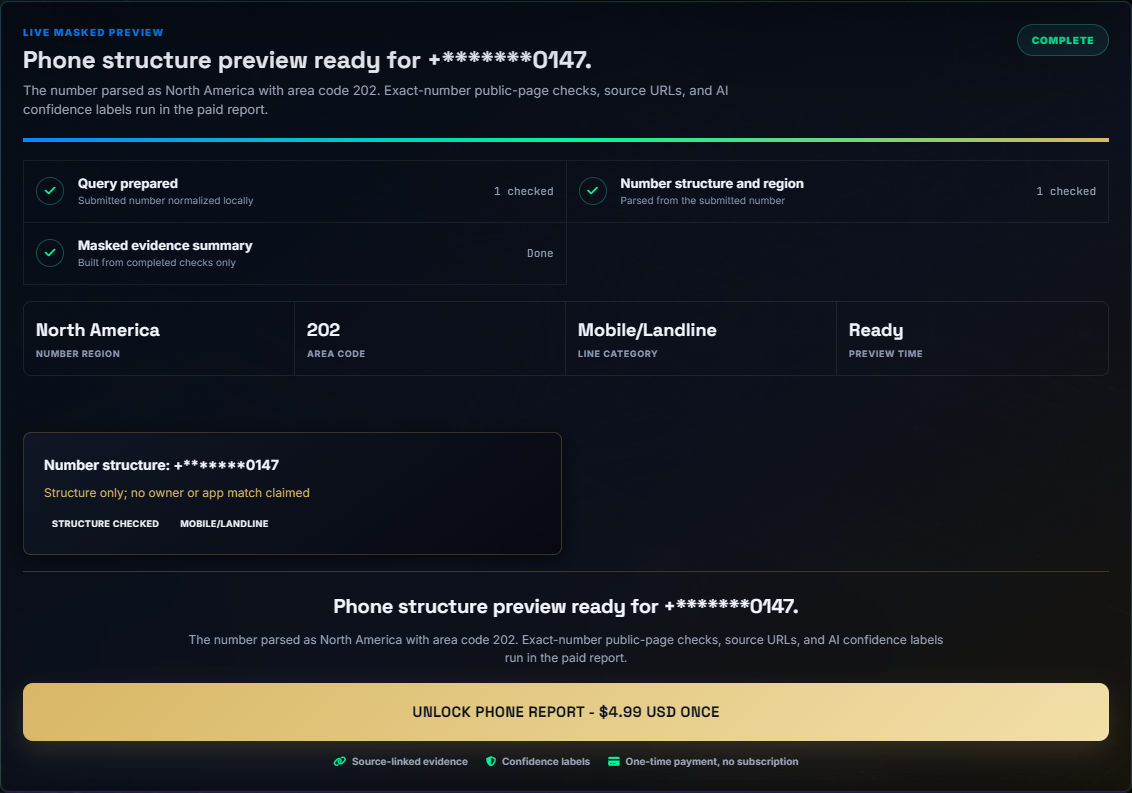
4. Run a reverse lookup. A search engine only shows what's been indexed. A proper reverse phone lookup checks the public footprint behind the number across browser-visible sources, looking for exact-number references, business pages, and public profile candidates when available. PrufAgent starts with a free structure preview, then shows the exact $4.99 one-time report before checkout. A thin public footprint is not proof of fraud, so verify the caller through the organization's official published number before acting.
Check the number before you call back
Start with the free structure preview. The paid report runs exact-number public-page checks and labels what the sources actually support.
The 2026 Scam-Call Red Flags
If the call connects, scammers reveal themselves through a predictable script. Any one of these is a strong signal; two or more is a near-certain scam.
- Urgency and threats. "Your account will be suspended in one hour." "There's a warrant for your arrest." "Your SIN has been linked to a crime." Real agencies do not threaten arrest over the phone and never demand instant action.
- Unusual payment methods. Gift cards, cryptocurrency, e-transfers to a personal address, or "Bitcoin ATMs." No real bank, government office, or utility collects payment this way. Ever.
- They called you about a problem you didn't report. A surprise call about "suspicious activity" you never flagged is a classic opener. Hang up and call the institution directly using the number on your card or their official website.
- Requests for codes or remote access. A six-digit verification code read aloud, or a request to install AnyDesk/TeamViewer "to fix your computer," hands the scammer your accounts or device.
- Recorded voice or AI clone. 2026 scams increasingly use AI voice cloning — a "relative" in distress, or a robocall that responds naturally. If a familiar voice asks for money urgently, hang up and call that person back on their known number.
- They discourage you from hanging up or checking. "Don't tell anyone." "Stay on the line." Pressure to not verify is itself the tell.
Why the Caller ID Is Lying to You
The single most important thing to understand: the number on your screen is not proof of who is calling. Caller ID spoofing lets a scammer display any number they want — including the real, published line of your actual bank, a government department, or a local business.
The nastiest version is neighbor spoofing: the call appears to come from your own area code and even your first three digits, because we instinctively trust a "local" number and are more likely to answer. The displayed number can also match a real person who has nothing to do with the call — which is why innocent people sometimes get angry callbacks for "scamming" when their number was simply spoofed.
Anti-spoofing standards (STIR/SHAKEN in Canada and the US) help carriers flag some unverified calls, but enforcement is uneven and scammers route around it. Treat the caller ID as a hint, never as identification. This is exactly why a search of the displayed number can be misleading on its own, and why a footprint-based lookup is more useful: it tells you whether the number has any legitimate history behind it.
How to Check an Unknown Number, Step by Step
When you have a moment to investigate a number that called, voicemailed, or texted you:
- Search the exact number in quotes. Include and exclude the country code to catch both formats. Scan the first page for complaint sites and official business listings.
- Check the area code against the claim. A "local hydro company" calling from an overseas code, or a "CRA" call from a cell number, is a mismatch worth distrusting.
- Never use the call-back number from a voicemail. If "your bank" left a message, find the number yourself on the back of your card or the official website and call that.
- Run a reverse phone lookup for the full picture. This is where a tool earns its keep. PrufAgent maps the public footprint tied to the number — public profiles, reused usernames, and business associations — so you can judge whether it's a real, traceable line or a throwaway. It's an honest read of public signals, not a magic owner database: for a freshly spoofed or low-footprint number, it will tell you plainly that there are no strong matches, which is itself useful information.
For Canada-specific patterns — CRA impersonation, the bank-investigator scam, and the 7-point local test — read our deeper guide on how to tell if a Canadian phone number is a scam.
What to Do If You Suspect (or Confirm) a Scam
If you haven't engaged yet: don't answer, or hang up immediately. Block the number. Report it — in Canada to the Canadian Anti-Fraud Centre (1-888-495-8501), in the US to the FTC at reportfraud.ftc.gov. Reporting feeds the databases that protect the next person.
If you talked but gave nothing: you're fine. Block, report, and move on. Expect follow-up calls — scammers share lists of people who pick up, so consider tightening your call-screening.
If you gave information: move quickly.
- Banking or card details — call your bank's fraud line now and freeze the affected cards.
- A password — change it and every account where you reused it, then turn on two-factor authentication.
- A verification code — that account may already be compromised; reset it and check recent activity.
- Your SIN, ID, or address — place a fraud alert with Equifax and TransUnion to guard against identity theft.
- Remote access to your device — disconnect from the internet, uninstall the remote-access app, change passwords from a clean device, and run a malware scan.
While you're tightening things up, it's worth knowing what a scammer can already piece together about you. If your email turned up in a breach, your passwords and security answers may be circulating. A quick email breach check shows which leaks exposed your address, and a full digital footprint check shows what a stranger can find about you from a single phone number or email.
Stop guessing about that number
Run the number that just called you through PrufAgent. We map browser-visible public references tied to the number so you can decide with facts, not a hunch.
Preview the number freeFree structure preview · $4.99 one-time report only if you continue · no subscription
Reduce the Calls in the First Place
Scam calls thrive on exposed contact data. The more your phone number is floating around data-broker and people-search sites, the more lists it lands on. Two habits cut the volume:
- Shrink your exposure. Remove your number from people-search and data-broker sites that resell it. Our guide to removing your info from people-search sites walks through the highest-impact opt-outs.
- Use carrier and phone tools. Enable built-in spam filtering (Silence Unknown Callers on iPhone, Caller ID & Spam on Android) and your carrier's free spam-blocking service. They won't catch everything, but they cut the obvious noise.
You can't go invisible, and any service that promises to make you "completely untraceable" is overselling. But shrinking your public footprint meaningfully reduces how often your number gets dialed by the next campaign.
The Honest Bottom Line
You can't always know who's behind an unknown number with certainty — caller ID can be faked, and a number that just got spoofed has no useful history yet. What you can do is stack the odds heavily in your favor: don't call back blind, ignore the caller-ID label, watch for the urgency-and-payment red flags, and run a lookup before you trust anyone who called you first.
When you want more than a search-engine guess, PrufAgent's paid phone report searches browser-visible exact-number references and labels what it can support after the free structure preview. It also tells you when checked public sources do not support a stronger match. Use that evidence alongside an independent call to the organization's official published number.
Run the free phone preview
Enter the number, review the structure, and see the exact $4.99 one-time report offer before Stripe. No subscription.