Find a Facebook account by email address
Enter a complete email address to check exact public mentions, username reuse, linked websites, identity clues, and public Facebook citations. The preview is free and does not require an account.
Free masked email preview | No account required | Public sources only
Can you still search Facebook by email in 2026?
Sometimes, but not through a dependable public email directory. Facebook limits email-based account discovery through privacy settings, and personal contact fields are usually hidden. An email can still appear on a public Facebook page, public post, business listing, event page, creator profile, or a separate website that identifies the same person or organization.
That makes email-to-Facebook discovery an evidence-correlation task. The address is the starting clue. A stronger result connects it to an independent name, organization, location, official website, or reused public username before treating a Facebook profile as relevant.
What counts as a stronger match?
- The complete email appears on a public Facebook page, post, or profile citation.
- An official website ties the email to the same name or business shown on Facebook.
- A distinctive reused username is supported by matching biography, location, role, or domain evidence.
- The source is current, reachable, and does not conflict with another person or organization.
Run an email-to-Facebook search without guessing
The workflow starts with the exact address, expands only through supported public clues, and keeps every identity claim tied to reviewable evidence.
What a public result may contain
1. Source-linked public references
A report can cite browser-visible pages that provide relevant email or profile context. Shared, outdated, or organizational addresses still need careful interpretation.
2. Public identity context
Displayed names, organizations, roles, and locations may help assess a candidate, but no single detail proves who controls an email address or Facebook profile.
3. Confidence and conflicts
Confidence labels summarize the available public context while preserving same-name, reused-handle, stale-source, and conflicting-detail risks.
4. Coverage limits
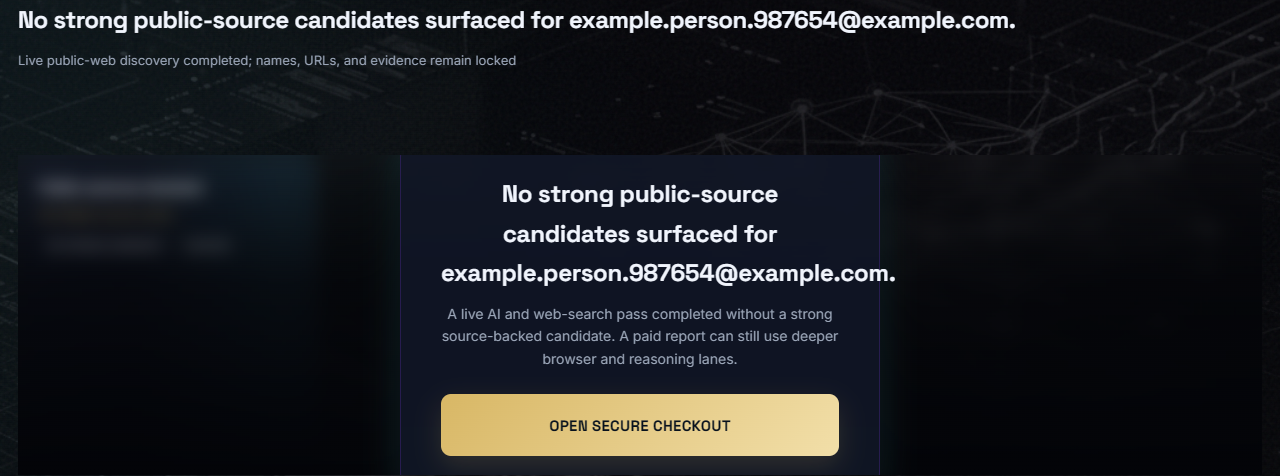
A report may return no supported Facebook candidate. Private profiles, registration records, messages, and unavailable pages remain outside public-source coverage.
Methods PrufAgent does not use
PrufAgent does not probe account recovery, send password-reset messages, upload someone else's contacts, access Messenger, or bypass Facebook privacy controls. Those actions are not part of a public-source report.
Why an email search may return no Facebook match
A correct search can finish without a supported profile. That is more useful than receiving a confident-looking false match.
- The account holder disabled email-based discoverability or never published the address.
- The email is private, new, disposable, misspelled, or no longer used.
- The public web contains the address but no corroborating Facebook URL or identity context.
- The email username is common and candidate profiles conflict with the available name, domain, or location.
- Facebook exposes only a login wall or inaccessible page that cannot support a public claim.
What an email-to-Facebook report can include
- Reachable pages where the complete email appears publicly.
- Candidate names, organizations, websites, and locations tied to those citations.
- Reused public usernames supported by additional identity context.
- Public Facebook URLs or references when corroborating evidence supports them.
- Source status, evidence text, timestamps, and confidence labels for review.
- Aggregate infostealer exposure status for supported email reports, without raw stolen data or historical breach catalogs.
Start with the complete email address.
Review the free masked preview before deciding whether the source-linked Profile Crosscheck is worth $9.99.
Facebook email address search FAQ
Can I find a Facebook account from an email address?
Sometimes. An exact public email mention, official website, reused username, name, or public Facebook citation can support a match. Facebook privacy settings mean an email address alone cannot guarantee a direct result.
Does Facebook still allow direct email searches in 2026?
Direct discovery is limited and depends on the account holder's privacy settings. Public pages, posts, websites, and corroborating profiles may still connect an email to a public Facebook presence.
Does PrufAgent use Facebook password recovery?
No. PrufAgent does not probe password recovery, send reset messages, upload contacts, or access private Facebook account data.
What does the free preview show?
The free preview masks the email and shows public-source candidate and category counts when available. Detailed source URLs and evidence remain locked until checkout.
How much is the crosscheck report?
A Profile Crosscheck is a $9.99 one-time purchase with no subscription. It includes source links, confidence labels, and evidence notes from supported public sources.
Can PrufAgent access private Facebook profiles or Messenger?
No. It cannot read private profiles, Messenger, hidden contact fields, private groups, or Facebook's internal account database.
What does a zero-result report mean?
It means the checked public sources did not support a Facebook connection at search time. It does not prove that no private, unindexed, deleted, or inaccessible account exists.