Supported structure
The engine can normalize a plausible international or North American number and explain whether its structure is supported. Structure confirms only that the clue can be searched, not who owns it.
Start with an exact phone number. PrufAgent checks supported number structure and searches browser-visible public references, profile pages, websites, business listings, aliases, and identity details, then shows a masked preview before any one-time purchase.
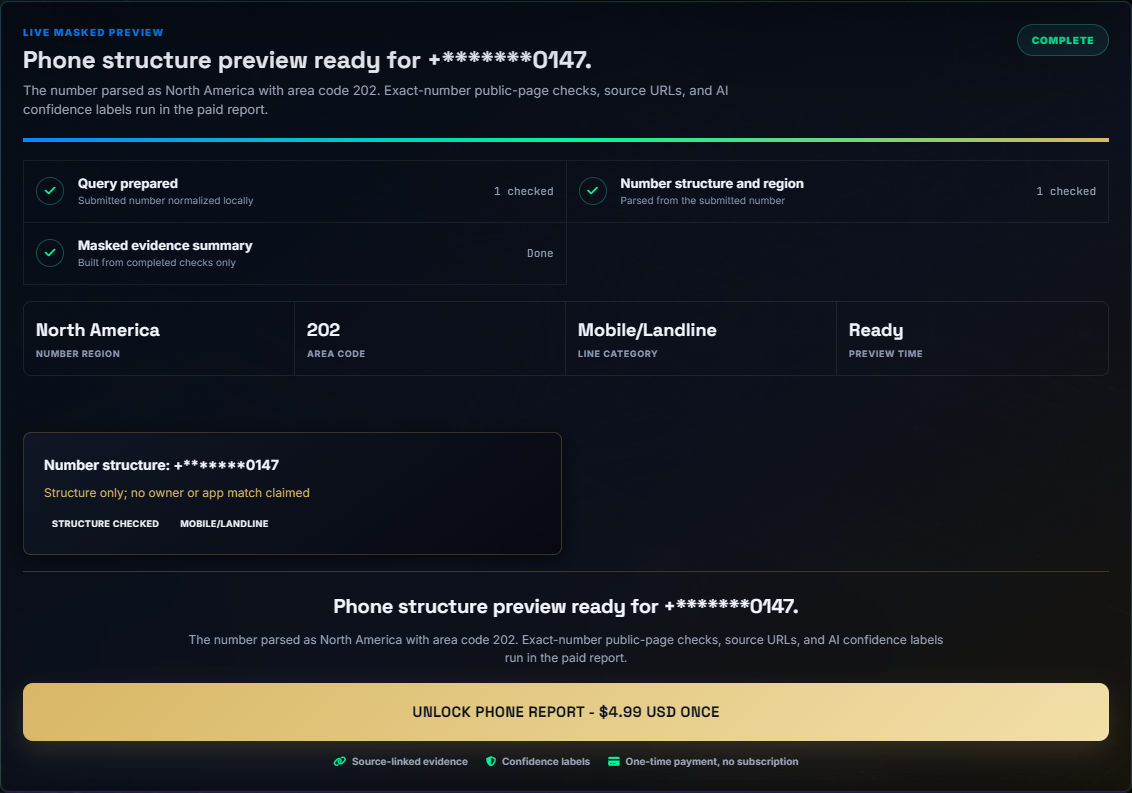
This is a real PrufAgent phone preview capture. It separates number structure, checked coverage, exact-number references, source evidence, possible candidates, and limitations so a phone number cannot become an invented person or profile.
Switch modes above to see the email, username, or name product view. A paid phone report can include supported number structure, cited public URLs, evidence notes, source-quality labels, confidence, conflicts, and checked-source limits.
Phone numbers can move between people, families, businesses, devices, and services. A report must show what a current public source says without silently converting an old reference into a present owner.
The engine can normalize a plausible international or North American number and explain whether its structure is supported. Structure confirms only that the clue can be searched, not who owns it.
The complete number may appear on a public contact page, business listing, organization page, public profile, advertisement, forum, document, or indexed post. The source and date determine its value.
A public page can connect the number to a name, username, website, organization, location stated by the source, or another identifier. Each connection still needs corroboration.
A candidate may show an old business, wrong region, unrelated biography, or incompatible date. A useful report preserves those conflicts instead of selecting the most dramatic hit.
The first pass removes display punctuation, identifies a plausible country-code interpretation, and preserves the exact clue for the report flow. A domestic-looking number can be ambiguous without a country or region. The normalized search should not invent missing digits or silently choose a person.
The second pass looks for the complete number in browser-visible sources. Public pages may format the same digits with spaces, parentheses, hyphens, or an international prefix. Every occurrence must be read in context. A number on a business contact page may identify a reception line, not an employee. A number in an old advertisement may no longer belong to the advertiser.
The final pass compares surrounding names, organizations, websites, locations, dates, usernames, and profile links. A consistent first-party page plus an independent public profile can raise confidence. A copied directory record repeated across several sites is still one underlying claim.
AI broadens discovery, compares candidate identities, and organizes evidence. It does not bypass authentication, and model output alone is never accepted as proof.
The application validates supported structure, masks the clue in public UI where appropriate, and sends the correct phone scan mode to the crosscheck report workspace.
Available browser-visible pages and structured providers are checked. A source page, search snippet, redirect, generic landing page, block, deletion, and login wall remain different outcomes.
AI-driven models search for relevant exact-number references, compare candidate identities, identify conflicts, and structure source-backed findings.
The report presents cited URLs, evidence notes, source quality, confidence, conflicts, and limitations. Unconfirmed candidates stay unconfirmed instead of becoming facts through repetition.
The underlying public source, not model output alone, is what can support a finding. A public profile URL, contact page, document, or indexed exact-number reference should carry a clear note explaining what it shows, when it was observed, and what remains uncertain.
A model can propose a search query or identify that two pages share a name and website. It cannot prove current number ownership from those similarities. First-party public pages generally deserve more weight than copied directories, unattributed lists, old snippets, or anonymous posts.
When providers fail or disagree, the report should show the limitation. A missing result is preferable to an invented owner, location, email, or social profile. That evidence discipline is what makes the AI useful for real research.
Social platforms decide whether contact fields, profiles, and pages are public or indexed. PrufAgent can organize browser-visible evidence; it cannot promise a private phone-to-account mapping that a platform does not expose.
| Evidence type | What it can support | What it cannot support alone | PrufAgent treatment |
|---|---|---|---|
| Exact number on a current first-party public page | Strong page-level association | Personal ownership of a shared or business line | Cite the page, capture context and date, then compare another identifier. |
| Exact number on a public profile | That the profile publicly displayed the clue | Current control, private activity, or complete identity | Compare name, biography, website, organization, location, and recency. |
| Copied directory or old advertisement | A lead to locate a better source | Freshness or present ownership | Seek the underlying page and label staleness, sharing, and copy risk. |
| Matching name or location without the number | Context for a known candidate | Any direct phone-to-profile association | Keep separate until a public source connects the identifiers. |
| Private, blocked, or login-only page | Only that public access was unavailable | Profile contents, membership, or account ownership | Record the limitation. Do not infer hidden details or bypass access controls. |
Facebook documents that members can control who Facebook may suggest their profile to based on a phone number or email address. Facebook also documents controls over who can see contact information. Those platform features do not create a public database PrufAgent can inspect, and a suggestion shown to one logged-in user is not public ownership proof.
Review Facebook's guidance on profile suggestions based on contact details and how Facebook uses contact information.
The US Federal Communications Commission operates a Reassigned Numbers Database to help callers avoid reaching people who did not receive the original intended call. That exists because a number can stop belonging to one subscriber and later be assigned to another.
Read the FCC's Reassigned Numbers Database overview. PrufAgent does not claim that a public reference establishes the current subscriber.
The same public-evidence rule applies. A public bio, profile URL, linked website, contact page, public post, business page, or organization directory can be reviewed. Private profiles, personalized recommendations, synced contacts, direct messages, app-only screens, hidden registration fields, and login-walled pages are outside the report's promise.
Platforms change indexing, page structure, access controls, and privacy defaults. A page that was public may become private, a username may change, and a search engine may retain stale text. The report should state what was checked now and cite the source that was actually observed.
A number appearing beside a messaging-app icon on a public business page supports a business contact path. It does not prove a personal social account, private conversation history, or the identity of every person who answers that line.
A useful phone search is a sequence of checks. Each step should add corroboration, expose a contradiction, or establish a clear access limit.
Include the country code when known. Do not guess missing digits. Keep the original formatting as context while searching normalized variations that preserve the same complete number.
Check the complete digits with common public formatting. Inspect the page around every occurrence and record the source URL, date, surrounding name, organization, website, and whether the source is first-party or copied.
Follow public links from the strongest source. Compare names, biographies, profile images, locations, organizations, websites, dates, and recurring aliases. Require independent agreement before confidence rises.
Ask whether the reference could be old, shared, or business-facing. A newer first-party source may outweigh an older directory, but it does not erase the history. Preserve both with dates.
Start with pages that directly publish the number: a current official contact page, public profile, personal website, organization directory, business site, or creator page. Read the surrounding text instead of relying only on a search snippet.
Secondary reporting, public documents, archived pages, and reputable directories can add context. Copied aggregators, scraped lists, unattributed databases, and snippets should be treated as leads because they may repeat one stale source.
Count independent evidence, not duplicate text. Several directories displaying the same old number do not create several confirmations. A report should identify likely copied content and prioritize the original source where available.
This page starts with phone because that is the clue you brought. The same tool can route an email, username, or name with place through its correct preview and report path.
Best for supported number structure and exact-number public references. Numbers can be reassigned, shared, ported, or published for a business.
Report: Phone Clue, $4.99 once
Best for exact public address references, possible aliases, linked websites, public profiles, and source-specific exposure context. Old references do not prove present control.
Report: Public Signal, $9.99 once
Best for cross-platform public handle trails. Identical usernames require biography, location, image, website, organization, or another verified identifier before confidence rises.
Report: Public Signal, $9.99 once
Best for contextual discovery when you have a verified city, region, employer, school, organization, profession, or business. Common names need more context.
Report: Public Signal, $9.99 once
If the phone search, email search, and likely username search point to the same website, organization, biography, and public profile, the combined trail may be more coherent. If one page predates a known reassignment or the username has an unrelated biography, preserve the conflict.
Do not enter guessed emails or usernames simply to produce more results. A fabricated identifier creates noise and can implicate an unrelated person. Use clues supplied directly, published publicly, or otherwise obtained for a legitimate purpose.
When two candidates remain plausible, keep both and label the uncertainty. A report that shows two unresolved people is more useful than a polished but unsupported choice.
The masked preview runs first. The app then shows the selected report type, exact price, included evidence, and one-time purchase disclosure before opening Stripe.
For an exact phone clue. The report checks supported number structure and public exact-number references, then labels only what checked sources support.
For email, username, or name-with-context searches. The report can include public candidates, cited URLs, evidence notes, quality labels, confidence, conflicts, and limitations.
An exact number can surface public web references, public profile candidates, websites, business pages, aliases, and identity clues when sources expose them. It cannot guarantee access to a private, blocked, deleted, or login-only profile.
No. PrufAgent searches browser-visible public sources and cites supported profile candidates. It does not claim private platform APIs, hidden registration records, account recovery access, or a way around privacy settings.
It can reveal supported number structure, exact public number mentions, public profile URLs, business or personal websites, names, aliases, locations stated by sources, and conflicts between candidates.
No. Numbers can be reassigned, shared, ported, published for a business, or left on stale pages. Confidence improves only when independent details such as name, location, biography, organization, website, and another verified identifier agree.
It means the checked public sources did not support a stronger finding at that time. It does not prove that no private, renamed, deleted, blocked, or unindexed social profile exists.
The masked preview is free. The Phone Number Crosscheck costs $4.99 once and is not a subscription. The exact product and price are shown before Stripe checkout.
No. PrufAgent is not a consumer reporting agency and must not be used for employment, tenancy, credit, insurance, or another regulated eligibility decision.
Focus an exact-number search on browser-visible Facebook clues and Facebook's contact-privacy limits.
Find Facebook clues by phoneSearch broader exact-number public references and supported phone clue context.
Open reverse phone lookupUse an exact email when the number produces sparse, stale, shared, or business-facing results.
Search social profiles by emailFollow a public handle across browser-visible profiles while preserving identity conflicts.
Find someone by usernameFollow a clue-by-clue workflow for public profiles, source review, and identity confidence.
Read the social search guideUse the dating-focused page when relationship context and dating-adjacent public references matter.
Search dating clues by phoneEnter the number, review the masked public signal shape, and see the exact $4.99 one-time report price before checkout.
Search a phone
Use only for lawful public research. Do not use PrufAgent for stalking, harassment, or regulated eligibility decisions.
Free masked preview. The selected one-time price appears before checkout. No subscription.