Current public-web search

People search alternative without a subscription

Start with a name and place, username, email address, or phone number. PrufAgent checks current public-web clues, shows a masked preview first, and offers a source-linked report only when you choose to continue.

  • Free masked preview before checkout
  • Source URLs and confidence labels in paid reports
  • $9.99 Public Signal Report or $4.99 Phone Clue Report, paid once
What clue do you have?
Add location context when a name is common.

The form hands your clue to the PrufAgent app. Do not search for harassment, stalking, or regulated eligibility decisions.

Free preview. No subscription. The selected one-time report price is shown before checkout.

See the product

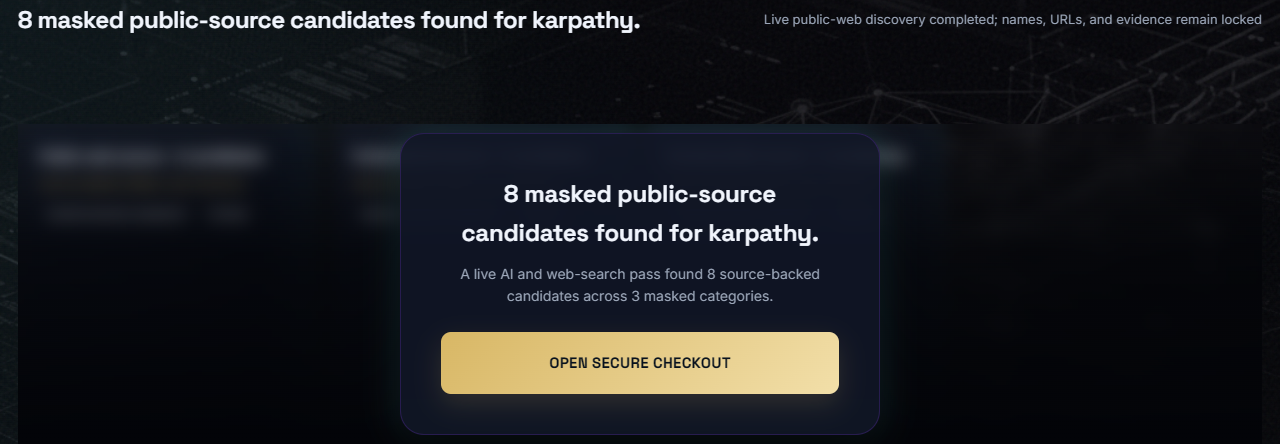
A real PrufAgent preview, not a stock mockup

The image is an actual product capture. PrufAgent separates checked source coverage, candidate evidence, and limits so a weak clue is not presented as a confirmed identity.

Change the search mode above to see the matching username, email, or phone product view. The paid report can contain public source URLs, evidence text, and confidence labels when sources support them.

PrufAgent public signal preview showing source coverage and masked public-web clues
Actual PrufAgent preview capture. Individual results vary with the clue and public source availability.
Match the tool to the job

When PrufAgent fits, and when another source fits better

“People search” can mean several different jobs. A current public profile, an old address, a reverse image, and an official court record are not the same kind of evidence. Start by deciding what you actually need.

Use PrufAgent for current public-web clues

PrufAgent is built for browser-visible evidence around the identifier you supply.

  • A name with city, region, employer, or organization context
  • A username or alias that may appear across public pages
  • An email address referenced on public pages
  • An exact phone number found in public web results
  • Source-linked clues you can inspect yourself

Use a different source for stored or official records

PrufAgent does not claim to replace specialized databases or official record custodians.

  • Historical addresses, relatives, property, or vehicle records
  • Photo-first reverse-image matching
  • Certified court, land, licensing, or corporate records
  • Professional screening under applicable law
  • Private accounts, private messages, or password-protected content
Your questionBetter starting pointWhy
Where does this name or alias appear on the public web now?PrufAgentCurrent public source discovery, URLs, and confidence labels are the core job.
What public pages reference this exact email or phone?PrufAgentExact-identifier public-web checks can surface inspectable references without claiming a private database match.
What are this person's old addresses, relatives, property, or vehicles?Traditional records serviceThose questions usually depend on stored public-record and directory datasets that PrufAgent does not claim.
Where else does this photo appear?Reverse-image servicePrufAgent can extract visible clues from an upload, but it does not locate copies of the photo or identify faces.
What is the official legal record?Official agency or qualified professionalSearch engines and commercial reports are not substitutes for an authoritative record.

Choose the input with the least ambiguity

An exact username, email address, or full phone number is usually a narrower starting clue than a name. When a name is all you have, include the most legitimate context available, such as a city, province or state, employer, school, business, profession, or organization. “Jordan Smith, Halifax photographer” gives the engine more useful context than “Jordan Smith” alone and gives you more facts to compare with any candidate.

Do not add details you merely suspect. Incorrect context can steer a search toward the wrong person. Begin with facts you can support, review the source links, and run a second identifier separately when you have one. Agreement between independently searched clues is more useful than repeating the same assumption in several forms.

Separate discovery from verification

Discovery asks which public pages might relate to a clue. Verification asks whether enough independent evidence supports a specific conclusion. PrufAgent can help with discovery and organize evidence for review, but the user remains responsible for verification. A profile can copy another person's photo, a directory can preserve an outdated phone number, and an old page can describe a former job or location.

For an important claim, open the original sources, compare dates, and look for consistent details that would be difficult to share by coincidence. When the evidence conflicts, label the result unresolved. A careful unresolved answer is more reliable than forcing one candidate to fit.

How it works

From one clue to evidence you can check

The workflow is designed to show uncertainty instead of hiding it behind a confident-looking name.

Enter the strongest clue

Use the exact username, email, or phone when available. For a name, add a location, employer, organization, or known alias to reduce same-name noise.

Review the masked preview

The free preview shows whether a source check completed and whether potentially useful public signals are available. It does not expose a full report before purchase.

Unlock only if useful

Choose a one-time report only after seeing the preview and exact price. Review the source URLs, evidence text, confidence labels, and coverage limits before drawing a conclusion.

Evidence, not certainty theater

What a public-web people search can and cannot establish

A public-web match is a lead, not automatic identity proof. The same display name can belong to many people. A reused username can be coincidence. A public email mention may be old, copied, or connected to an organization rather than an individual. A phone number can be reassigned. Each clue must be compared with the context you already know.

Stronger conclusions come from independent agreement. A username, location, profile image, employer reference, and linked website that point in the same direction are more useful together than one generic directory result. PrufAgent labels evidence and confidence so you can see the basis for a candidate instead of receiving an unexplained answer.

Public coverage also changes. A source may remove a page, block automated access, require login, expose different information by country, or prevent indexing. A report describes the public evidence available during the search. Recheck important sources directly before acting.

A sparse report can be an honest result. PrufAgent does not invent an owner name, linked profile, carrier, email, or exposure when checked sources do not support one. Try a more exact identifier or add legitimate context rather than treating weak similarity as proof.
Useful reasons to run a public search

You might review your own name and usernames before applying for a public-facing role, check whether an unfamiliar contact's public claims agree across sources, reconnect a business name with a public website, or understand why an old email or phone appears online. These uses begin with information already known to you and focus on public evidence rather than intrusion.

For self-searches, record which source publishes each item and use that source's correction or removal process when information is wrong. Removing one search result does not necessarily remove the underlying page. Work from the original publisher outward.

Reasons to stop and use another process

Stop when the purpose is to locate someone who has asked not to be contacted, expose a private address, pressure or threaten a person, gain access to an account, or make a regulated eligibility decision. A public clue is not permission to contact, publish, or confront someone.

Stop as well when only a generic same-name result supports the theory. Ask for direct verification, consult the relevant official record, or leave the conclusion unresolved. Better evidence should narrow uncertainty without creating risk for an unrelated person.

Clear one-time pricing

Preview first. Pay once only if you continue.

The landing page sends you into the working preview flow. It does not send you directly to a hidden checkout.

Public Signal Report

$9.99 one time

For name with location context, username, or email searches. The report can include source-linked public candidates, evidence text, confidence labels, and explicit limits.

  • Free masked preview first
  • No recurring membership
  • No claim of a deep public-record database
Start public preview

Phone Clue Report

$4.99 one time

For an exact phone clue. The report checks supported number structure and public exact-number references, then labels the evidence that the checked sources support.

  • Free masked phone preview first
  • No recurring membership
  • No invented owner, email, carrier, or profile
Start phone preview
Responsible use

Public information still requires judgment

PrufAgent is useful for reviewing your own digital footprint, checking a public claim, reconnecting public identifiers, or investigating a suspicious contact using lawful public evidence. It should not be used to harass, stalk, threaten, impersonate, or expose sensitive information about another person.

PrufAgent is not a consumer reporting agency. Do not use its reports for employment, housing, credit, insurance, or other regulated eligibility decisions. For those decisions, use a qualified provider and follow the law that applies to your location and purpose.

The service does not bypass passwords, privacy settings, logins, or platform controls. It does not search private messages. Public evidence can still be inaccurate or outdated, so contact the relevant source or record custodian when a decision depends on correctness.

Frequently asked questions

People-search alternative questions

Can I use PrufAgent without a subscription?

Yes. The masked preview is free. A Public Signal Report costs $9.99 once, and a Phone Clue Report costs $4.99 once. Neither report is a subscription.

What can I search on PrufAgent?

You can start with a name plus location, username, email address, or phone number. Exact coverage depends on what current public sources expose for that clue. Location or organization context can make a common-name search more specific.

How is PrufAgent different from a traditional people-search site?

PrufAgent focuses on current browser-visible public-web references, source URLs, and confidence labels. It does not claim a deep stored database of address histories, relatives, property, vehicles, or court records.

Does PrufAgent search private accounts or private messages?

No. PrufAgent searches public signals and does not bypass passwords, privacy controls, or platform authentication. A private or unindexed account may not appear.

Does PrufAgent include reverse image search?

No. PrufAgent's Image Clues scan accepts JPEG, PNG, and WebP uploads to extract visible text, usernames, contact details, URLs, organizations, and location clues. It does not perform facial recognition or reverse-image matching; use a dedicated reverse-image service when the photo itself is the evidence.

What does a no-result people search mean?

It means the checked public sources did not support a stronger result. It does not prove that the person, account, email, or phone identity does not exist. A private page, changed identifier, blocked source, or small public footprint may explain the gap.

Can I use PrufAgent for employment, housing, credit, or insurance decisions?

No. PrufAgent is not a consumer reporting agency and its reports are not for employment, housing, credit, insurance, or other regulated eligibility decisions.

Continue your research

Focused guides and fair comparisons

Use the page that matches the clue you already have.

Start with evidence

Run the free preview before you pay

Choose name and place, username, email, or phone. You will see the matching report type and one-time price before checkout.

Start free preview