Normalize the clue
The app identifies whether the input is a name with context, username, email, or phone and sends it through the matching public preview and report path.
Start with a name and place, username, email, or phone. PrufAgent combines public-source checks with AI-assisted discovery and identity reasoning, then shows a masked preview before any one-time report purchase.
Public research only. Do not use PrufAgent for stalking, harassment, or regulated eligibility decisions.
Free masked preview. The selected one-time price appears before checkout. No subscription.
This is a real PrufAgent preview capture. It separates checked coverage, potential candidates, source evidence, and limitations so AI-generated text cannot masquerade as proof.
Switch modes above to see the matching username, email, or phone view. A paid report can include public source URLs, evidence notes, source-quality labels, and confidence labels when checked sources support them.
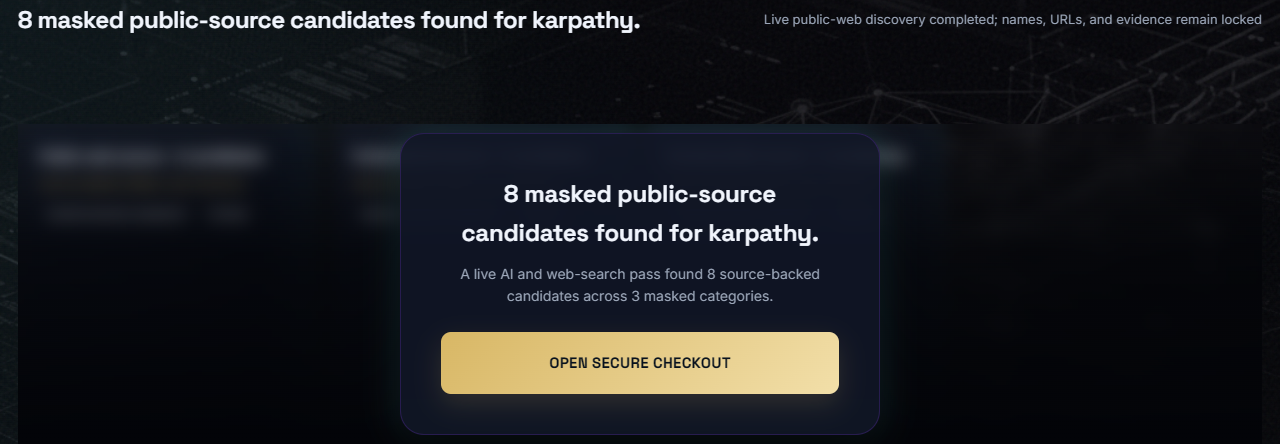
PrufAgent uses AI as one layer in a source-backed workflow. A powerful model can broaden discovery and compare evidence, but it cannot turn inaccessible or missing source material into a verified account.
The app identifies whether the input is a name with context, username, email, or phone and sends it through the matching public preview and report path.
Available providers and browser-visible pages are checked. Redirects, login walls, blocked pages, generic landing pages, and missing evidence remain distinct.
OpenRouter-routed discovery searches for relevant public references and identity reasoning compares candidates, conflicts, context, and source agreement.
The engine returns evidence notes, source URLs, quality labels, confidence, and coverage limits rather than an unexplained yes-or-no accusation.
PrufAgent currently routes its primary analysis and classification through DeepSeek V4 Pro, public-web discovery through Perplexity Sonar Pro Search, and identity reasoning through Grok 4.3. Llama 3.3 70B is configured as a fallback. Routing can change when model availability, quality, cost, or provider behavior changes.
Model diversity does not bypass a website's authentication or privacy controls. The AI receives only the evidence the application lawfully obtains. It cannot read private messages, open password-protected profiles, or guarantee access to a platform that blocks the request.
The important contract is therefore not a model name. It is whether the final report cites inspectable evidence, preserves uncertainty, resists false matches, and refuses to invent a profile, owner, carrier, email, or dating-app account when sources do not support one.
Discovery is deliberately broad. It asks which public pages might relate to the supplied clue and gathers candidate URLs, snippets, profile references, and contextual details. This is where AI search helps most: it can reformulate a query, recognize aliases, connect organization context, and find references that a rigid URL-template checker would miss.
Verification is narrower. It asks whether the page actually supports the claim being considered. A candidate must be compared with the original input and available context. A page that contains the same username but a different location is not equivalent to a page that also agrees on biography, website, organization, and another identifier.
The report keeps these stages distinct because a long candidate list is not the same as strong evidence. When discovery finds ten possible pages but verification supports none of them, the correct result is an unresolved or sparse report, not ten "matches."
Model-generated prose is not accepted as a source. Report evidence must point back to a URL or a structured provider response. The customer can inspect the cited page, see the source-quality label, and understand why the candidate received its confidence level. If a model names a platform but the underlying check cannot support the reference, the platform name is not promoted to a confirmed finding.
The engine also distinguishes absence from uncertainty. A blocked source means the source could not be checked. A missing page means the requested URL did not support a profile. A generic landing page means the platform exists but the individual account was not established. A conflicting candidate means some details agree while others do not.
This approach cannot eliminate every error. Pages change, search indexes lag, and public details can be false. It does make the error visible and reviewable instead of hiding it behind an authoritative AI sentence.
A primary public profile controlled through the relevant platform is generally more useful than a copied directory entry. A personal or business website can provide strong context when it links to the same handle. A news article, forum citation, or public organization page can corroborate details while remaining a secondary reference. Aggregators can help discovery but may be stale or copied from each other.
Confidence should therefore reflect more than the number of URLs. Five directories repeating one old record are not five independent confirmations. Two separate primary sources that agree on a distinctive username, location, and linked website may provide a more coherent trail.
AI systems are tempted to summarize away disagreement. PrufAgent treats conflict as information. A matching username with a different age, a matching name with an unrelated city, or a copied photo attached to another biography can be a reason to lower confidence or reject the candidate.
Customers should see enough evidence to make the same judgment. A report that lists only the supporting details creates false certainty. A useful report also says which expected details were missing, which sources were inaccessible, and which candidates were excluded or left unresolved.
The best starting clue is the one with the least ambiguity. Run separate clues independently, then compare results after each search finishes.
Use a full name with a verified city, region, employer, organization, school, profession, or business. A common name without context can produce unrelated candidates.
Best for: contextual public-web discoveryAn exact handle can surface public profiles, creator pages, forums, and web mentions. Handle reuse can help discovery, but identical usernames do not prove common ownership.
Best for: cross-platform public handle trailsAn exact email can appear on public websites, profiles, business pages, reputation services, or exposure-status providers. An old reference does not prove current control.
Best for: exact public email referencesAn exact phone clue can provide supported number structure and public exact-number references. PrufAgent does not invent a current owner, carrier, email, or profile.
Best for: narrow phone-clue reviewAI can find many pages that look related. Reliability improves when independent details agree: a location, linked website, profile image, organization, biography, or another verified identifier. One generated profile URL, similar display name, or reachable login page is weak evidence.
Search each strong clue separately. If a username search, public email reference, and name-with-location search point to the same website and organization, the combined trail is more useful than repeating the same assumption in every query. If they disagree, preserve the conflict instead of forcing a conclusion.
Public web evidence also ages. A phone can be reassigned, an email can be abandoned, and a profile can remain visible after someone stops using it. Reopen important sources and check dates before relying on a report.
Dating platforms often restrict search, require accounts, personalize results, or block automated requests. PrufAgent reports those limits instead of converting them into matches.
| Evidence type | PrufAgent approach | Important limit |
|---|---|---|
| Public indexed profile or mention | Can be discovered and cited when available | Indexing can be stale, partial, or removed |
| Reused username on social or creator pages | Can support a broader public trail | Same handle does not prove one owner |
| Public email or exact-number reference | Can be checked as a separate identifier | Reference may be old, business-related, or reassigned |
| Tinder, Bumble, Hinge, or other login-only profile | Reported only if a browser-visible public source supports it | No guaranteed direct member-database access |
| Private messages or hidden account data | Not searched | No password bypass or private-account access |
| Photo or screenshot clues | Image Clues extracts visible public clues such as text, usernames, contact details, URLs, organizations, and locations | No facial identification or reverse-image matching |
Open the original source and confirm it still exists. Compare dates, location, age, biography, photos, websites, and linked identifiers. Look for independent corroboration outside the suspected dating profile. Keep possible matches and conflicting results labeled as unresolved.
Do not confront, accuse, threaten, publish, or expose someone based on an automated candidate. A public profile cannot tell an AI the rules of a relationship, whether an account was abandoned, who currently controls it, or why it exists.
Use PrufAgent for lawful self-review, public-claim verification, anti-catfish research, and suspicious-contact checks. Do not use it for stalking, harassment, private-address exposure, employment, housing, credit, insurance, or other regulated eligibility decisions.
The free masked preview runs before checkout. The app shows the selected report type, exact price, and "No subscription" disclosure before opening Stripe.
For name with location context, username, or email searches. The report can include public source candidates, URLs, evidence notes, source-quality labels, identity-confidence labels, and limitations.
For an exact phone clue. The report checks supported number structure and public exact-number references, then labels only what checked sources support.
It means PrufAgent uses AI to discover, organize, compare, and summarize browser-visible public references around a clue. AI does not create access to private dating profiles, messages, or member databases.
PrufAgent can report public dating-adjacent references when browser-visible sources expose them. It does not claim direct access to private or login-only Tinder, Bumble, Hinge, or other dating-member data.
You can start with a name plus location, username, email address, or phone number. Exact identifiers usually reduce ambiguity more than a common name.
PrufAgent currently routes discovery and identity reasoning through OpenRouter and can change models as coverage, quality, and availability change. AI conclusions remain limited by the underlying public evidence.
Accuracy depends on source quality, identifier specificity, independent corroboration, and current platform access. A profile candidate is a lead, not proof of identity, recent use, or relationship conduct.
It means the checked public sources did not support a stronger result. It does not prove that no private profile, changed username, blocked page, or unindexed account exists.
The masked preview is free. A Public Signal Report for name, username, or email costs $9.99 once. A Phone Clue Report costs $4.99 once. There is no subscription.
Run the same four-input preview with a concise guide focused on public dating-adjacent clues.
Open dating profile searchUse a source-by-source anti-catfish checklist before sending money or sharing sensitive information.
Read the verification guideStart with an exact handle or email and understand what a public reference can establish.
Find by username · Reverse email lookupCheck supported number structure and exact-number public references without invented ownership claims.
Reverse phone lookupCompare one-time public-web reports with direct dating-profile, face-search, and monitoring products.
Cheaterbuster alternativeUse a photo-first method when an image is your strongest or only clue.
Reverse image search guideChoose name and place, username, email, or phone. Review the masked signal shape and exact one-time report price before checkout.
Start free preview