Exact public mentions
The full address may appear on a public website, contact page, forum, profile, directory, document, or indexed post. Exact text is useful discovery evidence, not automatic proof of current control.
Start with an exact email address. PrufAgent searches browser-visible public references, possible reused usernames, profiles, websites, and dating-adjacent mentions, then shows a masked preview before any one-time report purchase.
Use only for lawful public research. Do not use PrufAgent for stalking, harassment, or regulated eligibility decisions.
Free masked preview. The selected one-time price appears before checkout. No subscription.
This is a real PrufAgent email preview capture. It separates checked coverage, possible public candidates, source evidence, exposure context, and limitations so an AI sentence cannot masquerade as a verified dating profile.
Switch modes above to see the username, name, or phone product view. A paid email report can include cited public URLs, evidence notes, source-quality labels, identity-confidence labels, conflicts, and checked-source limits.
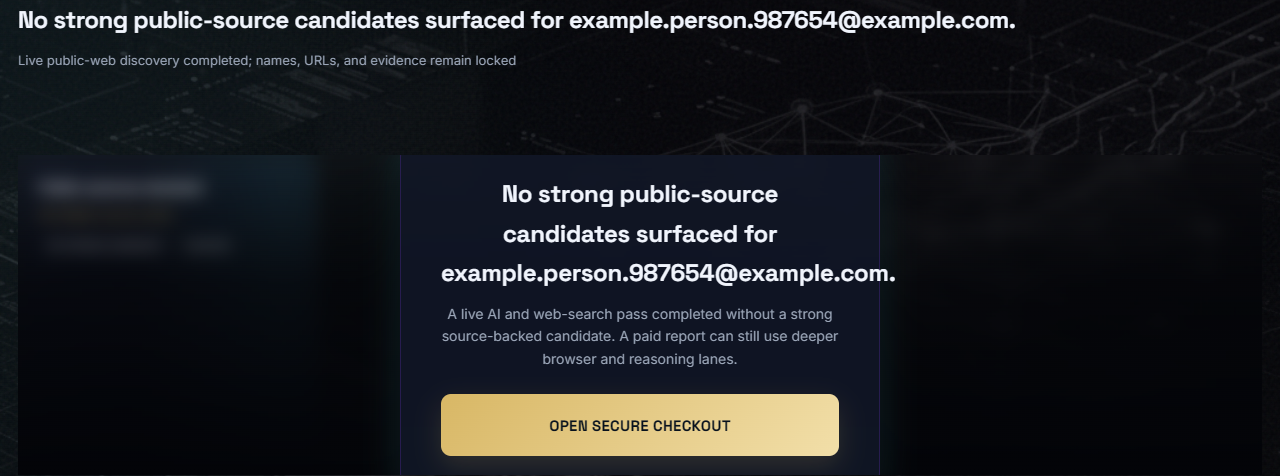
An email can be distinctive, but it may be old, shared, forwarded, compromised, used for a business, or disconnected from the person you are researching. Every candidate needs context.
The full address may appear on a public website, contact page, forum, profile, directory, document, or indexed post. Exact text is useful discovery evidence, not automatic proof of current control.
The text before the @ sign can suggest a handle to check on public pages. Common stems, initials, and random strings produce false candidates, so a derived handle remains weak until corroborated.
A personal site, organization page, creator profile, code repository, or social page may connect the email to a name, location, biography, website, or another identifier.
A public article, forum post, cached mention, profile page, or linked website may reference a dating platform. PrufAgent cites the page and does not convert the platform name alone into a confirmed account.
The engine begins with the complete normalized email because exact references are less ambiguous than a common display name. It can then look for public pages that repeat the same address, identify possible aliases or handle candidates, and compare contextual details. The domain also matters: a personal provider, school, employer, organization, custom domain, and disposable domain each create different context.
Next, search likely handles independently. A local part such as first.last may produce many unrelated people, while a distinctive long-running alias can connect several public pages. Do not assume ownership because a platform accepts the same username in a URL or shows a generic sign-in page.
Finally, compare independent details. Location, profession, organization, linked website, biography, profile image, and another verified identifier can strengthen or contradict a candidate. The report should preserve both supporting and conflicting details.
AI broadens discovery and compares candidate evidence. It does not bypass authentication, and model output alone is not accepted as proof.
The application validates and normalizes the submitted address, preserves the exact clue for the crosscheck report flow, and generates separate public-search candidates where appropriate.
Available browser-visible pages and structured providers are checked. Missing pages, generic landing pages, redirects, blocks, and login walls remain different outcomes.
AI-driven models search for relevant public references, compare candidate identities, detect conflicts, and organize source-backed evidence.
The report presents source URLs, evidence notes, source quality, confidence, conflicts, and coverage limitations instead of an unexplained yes-or-no accusation.
PrufAgent currently routes primary analysis and classification through advanced AI analysis, public-web discovery through AI web search, and identity reasoning through AI cross-check. AI fallback analysis is configured as a fallback. Routing can change when model availability, quality, latency, cost, or provider behavior changes.
Discovery asks which public pages might relate to the email. Verification asks whether those pages actually support the identity or platform claim. A search result snippet, generated profile URL, reachable login page, or same-name account is not enough.
When discovery returns ten possible pages and verification supports none, the correct result is unresolved or sparse. When a source is blocked, the report says it could not be checked. When details conflict, confidence should fall rather than forcing a match.
Several directories can copy the same stale record. Counting each copy as separate confirmation creates false confidence. A platform-controlled public page, a personal website, and an organization profile that independently agree on a distinctive alias and location are more useful than repeated aggregator text.
Source recency matters too. An email can be abandoned, a domain can expire, and a profile can remain indexed after its owner stops using it. Open important citations and check publication dates, update dates, and current page content before relying on the report.
Supported email reports may include source-specific exposure or infostealer-status context. That can help explain why an email is circulating or why suspicious messages appear. It does not prove a dating account, current password, private activity, or misconduct.
Never reuse exposed credentials, attempt account access, or contact unrelated people named in a leak. Use exposure information to secure the affected email: change passwords through the owner account, enable multifactor authentication, review sessions, and watch for impersonation.
Major dating platforms commonly require authentication, personalize discovery, restrict member search, or keep profiles out of public indexes. PrufAgent reports those boundaries instead of presenting blocked checks as matches.
| Evidence type | PrufAgent handling | Meaning |
|---|---|---|
| Exact email on a browser-visible public page | Can be cited and evaluated | Supports the page reference; current control still needs context |
| Reused username on a public social or creator profile | Can become an identity candidate | Same handle does not prove common ownership |
| Public dating-platform mention or indexed profile reference | Can be cited when the source is inspectable | May be old, copied, incomplete, or unrelated |
| Tinder, Bumble, Hinge, or another login-only profile | Reported only when a public source supports a reference | No guaranteed direct member search |
| Private messages, hidden membership data, or passwords | Not searched | No authentication bypass or private-account access |
| No public result | Returned as sparse, unresolved, or no result | Does not prove no private or unindexed account exists |
A public page cannot establish that an account is active now, that the searched person controls it, why the account exists, or whether private relationship rules were broken. A profile may be old, copied, impersonated, created before a relationship, or controlled by someone else.
Open the original source. Compare dates, location, age, biography, images, organizations, and linked identifiers. Search strong clues separately and preserve disagreement. A good report helps you review evidence; it does not make a personal accusation for you.
Use PrufAgent for lawful self-review, anti-catfish research, suspicious-contact checks, and public-claim verification. Do not use it for stalking, harassment, employment, housing, credit, insurance, or another regulated eligibility decision.
Public-source research is one part of a broader safety check. Pressure, secrecy, urgent payment requests, and paid verification links are stronger warning signs than a single ambiguous profile candidate.
The US Federal Trade Commission warns that romance scammers often move conversations off dating platforms, claim distance or emergencies, and ask for money. Do not send cash, gift cards, wire transfers, cryptocurrency, or account access to an online love interest you have not independently verified.
Read the FTC romance-scam guidance and report suspected fraud through the appropriate platform and government reporting channel.
The FBI's Internet Crime Complaint Center has warned about online-dating verification schemes that direct targets to costly recurring subscription sites and collect personal or payment information. Do not follow a stranger's link to prove your identity, age, or safety.
Read the IC3 verification-scheme warning. Navigate to official services yourself rather than using links supplied in an unsolicited message.
Keep early communication on the original platform while you evaluate the contact. Ask for a live video conversation that includes a natural, current interaction rather than a pre-recorded clip. Search the profile image separately with a reputable reverse-image tool. Compare the claimed name, location, occupation, timeline, and linked public pages.
Search the email, username, name with location, and phone independently. Agreement across unrelated public sources is more useful than repeating one assumption. If the person avoids basic verification, changes their story, pressures you to act quickly, or introduces an investment opportunity, stop and reassess.
This page starts with email because that is the query you brought. The same tool can also route a username, name with place, or phone through its correct preview and report path.
Best for exact public address mentions, possible aliases, linked websites, and source-specific exposure context. Old references do not prove current control.
Report: Public Signal, $9.99 once
Best for public cross-platform handle trails. Identical usernames require biography, location, image, website, or another identifier before identity confidence rises.
Report: Public Signal, $9.99 once
Best for contextual discovery when you have a verified city, region, employer, organization, school, profession, or business. Common names need more context.
Report: Public Signal, $9.99 once
Best for supported number structure and exact-number public references. Numbers can be reassigned, shared, ported, or published for a business.
Report: Phone Clue, $4.99 once
If the email search, likely username search, and name-with-location search point to the same website, organization, biography, and public profile, the combined trail may be more coherent. If the phone points to another region or the username has an unrelated biography, preserve the conflict.
Do not enter guesses simply to produce more results. A fabricated or inferred email creates noise and can implicate an unrelated person. Use clues supplied directly, published publicly, or otherwise obtained for a legitimate purpose.
The masked preview runs first. The app then shows the selected report type, exact price, included evidence, and one-time purchase disclosure before opening Stripe.
For email, username, or name-with-context searches. The report can include public candidates, cited URLs, evidence notes, quality labels, confidence, conflicts, and limitations.
For an exact phone clue. The report checks supported number structure and public exact-number references, then labels only what checked sources support.
An exact email can surface public web references, reused usernames, social profiles, and dating-adjacent mentions when those sources expose them. It cannot guarantee access to a private or login-only dating profile.
No. PrufAgent can cite browser-visible public references related to dating platforms, but it does not claim direct access to private or login-only Tinder, Bumble, Hinge, or other member databases.
It can reveal exact public email mentions, possible reused usernames, linked public profiles, websites, aliases, and dating-adjacent references. Every candidate still requires source review and identity corroboration.
No. A username derived from an email is only a discovery clue. Identity confidence improves when independent details such as location, biography, linked websites, photos, and another verified identifier agree.
It means the checked public sources did not support a stronger finding. It does not prove that no private, blocked, deleted, renamed, or unindexed profile exists.
The masked preview is free. The Profile Crosscheck costs $9.99 once and is not a subscription. The exact product and price are shown before Stripe checkout.
No. PrufAgent is not a consumer reporting agency and must not be used for employment, tenancy, credit, insurance, or another regulated eligibility decision.
Compare all four clue types and understand public dating-adjacent coverage.
Open dating profile searchSearch broader public identity, website, profile, and exposure context around an email.
Open reverse email lookupUse an exact phone clue when the email is unavailable or produces sparse public evidence.
Find dating profiles by phoneFollow a source-by-source anti-catfish checklist before sending money or sensitive information.
Read the verification guideSee how the AI engine discovery, identity reasoning, source labels, and confidence controls work.
Read the AI search guideUse a photo-first workflow when the image is stronger than the supplied email.
Open the reverse-image guideEnter the email, review the masked public signal shape, and see the exact $9.99 one-time report price before checkout.
Search an email